
11 November 2026 · By Alistair Greenwood
Where should a small business start with AI?
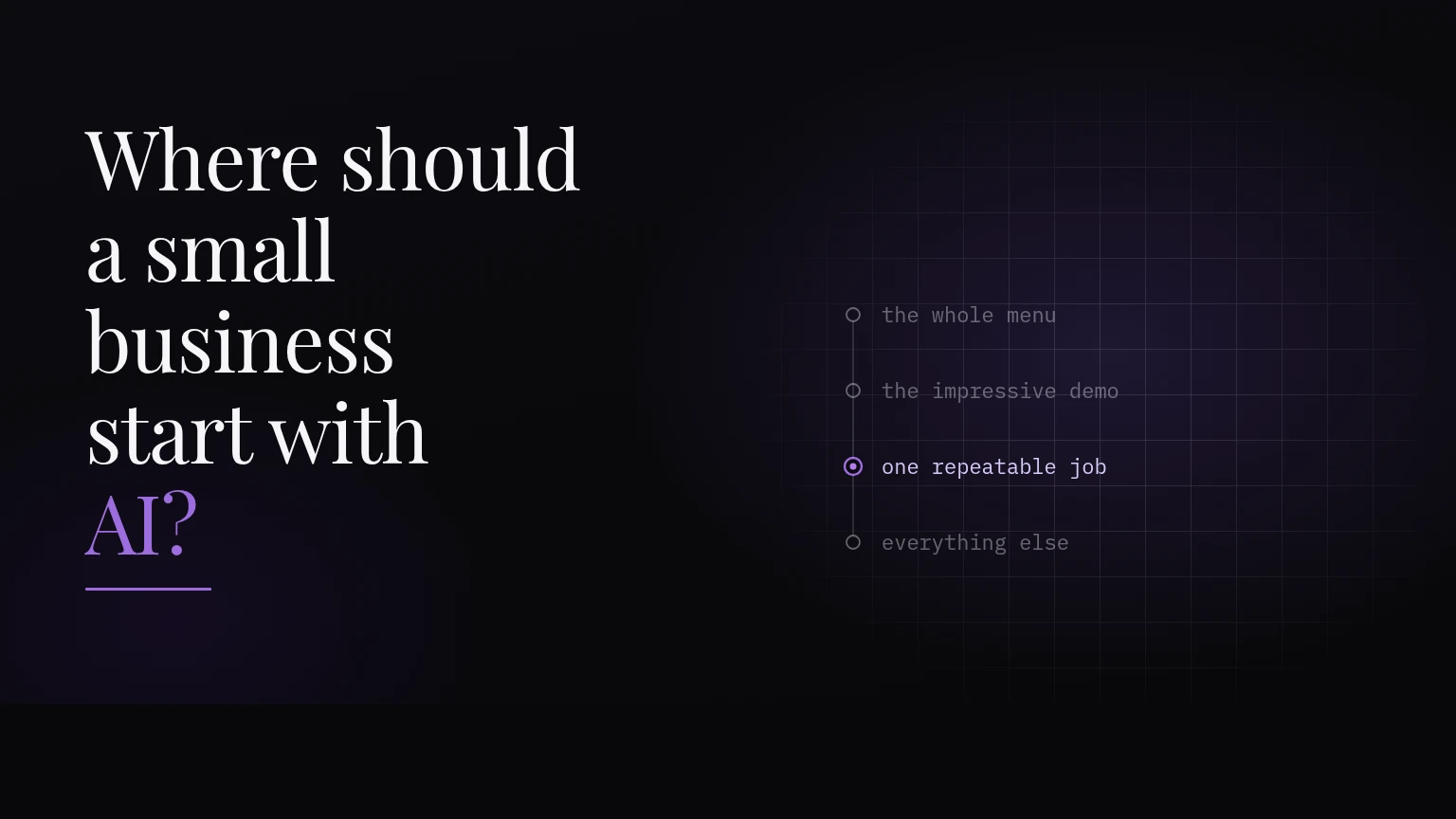
If you run a small business and you’re wondering where to start with AI, I’d begin with a list of what your team actually does in a normal week, then pick one job that’s repeatable, time consuming, and has a high propensity for human error. I’m Alistair Greenwood, I founded OmniforceAI, and that’s pretty much how we start with clients.
The thing she actually wanted
I was on a call with an exec where we’d basically laid out everything AI could do for her business, the whole menu. She said if she didn’t have to organise her inbox, it would save her so much time.
And I was like, we could do all of this stuff and you didn’t want us to organise your inbox, but it can be as simple as that, right? I do say there’s no point in using Einstein to organise the emails, and I still mean it, but for her the inbox was the thing that was actually costing her time every day, so that’s where the value was.
I get why people start with the impressive demo. I do the same when I see something cool. The job that’s quietly eating the week often doesn’t even come up unless you ask what the team is actually doing.
The three questions I ask
So if I were in your shoes, the first thing I’d do is sit down with the team and write out the work of a normal week, every task, including the dull ones, actually especially the dull ones. Then for each job I ask three things.
Is it repeatable. Does it have a high propensity for human error. Is it time consuming.
I’m not technical myself, so there’s nothing clever in those, anyone on your team can answer them.
The jobs that fit those questions are usually the low hanging fruit. It doesn’t look so sexy, but it’s really important, because quite often it’s something nobody would ever have put on a list of AI ideas. It was just part of the week.
I’d talk to the people who do the work, not only the person signing it off, because they know which jobs eat the time.
What happens when you zoom in
I wouldn’t try to cover the whole business at once. When we zoomed in on one initiative at a client, we had about 12 or 13 or 14 different automations, just from that one area. So I really wouldn’t worry about running out of things to do if you start narrow. I’d much rather go deep on one thing than spread thin across everything. That one list of automations came from a single initiative, which is why I still start smaller than people expect, even when they’re keen to look at the whole business.
The other thing I’d look at early is where the information for each job actually lives. If it’s in someone’s head, or split across a few different places, that’s the first bit of work, before any AI. In AI, context is everything, it’s the AI’s memory, and without it an agent has no real idea how the job is supposed to be done.
We call that a company brain, which is basically ingesting your current data and, more importantly, organising your future data so the context grows as you do. I start there because the inbox, or the report, or whatever the first job is, needs that context to work.
Why we don’t sell projects any more
We used to sell projects at OmniforceAI, the big scoped kind with a handover at the end. The way I put it on a call a while back was, we used to have project based and it doesn’t work, because by the time the project was literally delivered, everything’s moved.
These days we work in monthly sprints, one initiative at a time. When things change, which they will, you’ve only committed to a month, and you can pick the next one based on what you’ve learned.
I’d bring the people who do the work in from the start as well. The hardest part of my job is the human side, and I’ve learned that the long way.
What I’d do next week
If I ran your business, next week I’d get that list down, run the three questions, and pick one area to go deep on. Try it with something simple before you spend any real money.
If you’d like a rough idea of where you’d start, you can try our AI-readiness assessment. There’s more about me and how we work on my About page.
A few questions I get a lot
Where should a small business start with AI?
With the work your team already does every week. Write it down, then look for a job that’s repeatable, time consuming, and has a high propensity for human error. Start with one of those and go deep on it.
Do I need a big AI project to get going?
In my experience you don’t. We used to sell projects at OmniforceAI, and by the time they were delivered the business had already moved. A monthly sprint on one initiative is how we work now, and it’s a much easier way for a small business to begin.
What if the most useful job looks boring?
That’s pretty normal. I had an exec tell me the thing that would save her the most time was not having to organise her inbox, after we’d shown her everything AI could do. The boring job is often the one that’s quietly eating the week.
How do I know which job to pick first?
I ask whether it’s repeatable, whether it has a high propensity for human error, and whether it’s time consuming. The ones that fit those questions are usually the low hanging fruit, and there’s often more in that one area than you think. At one client, zooming in on a single initiative turned up about 12 to 14 possible automations.
I write on Substack. There’s more on applied AI and AI consulting on this site. If it’d help to jump on a call about where you’d start, just give me a shout.
Cheers, Alistair
By Alistair Greenwood. About Alistair Greenwood.